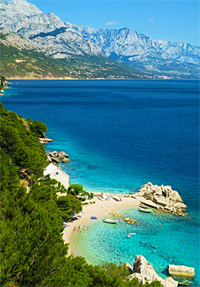

Although unable to be described as prominent with regard to its height or the wealth of its natural wealth, or the profusion of amazing karstic forms, Mosor has become the most popular mountain in Dalmatia. This karstic, at first glance quite formidable, massif extends from Kliski prijevoj (Klis Pass) in a south-easterly direction for about 25 km, all the way to the River Cetina, whose canyon forms a semi-circle around the mountain, thus providing it with a distinct natural boundary.
Located in its foothills, the area known as Zagorska Poljica, is a group of hamlets. The southern slope initially descends in terraces, and is dotted with numerous lovely plateaux. This terraced plateau descends almost through the entire length of the mountain down a rocky stairway the height of which ranges between 100 and 200 m, which is highly attractive from an Alpinistic aspect. Situated beneath it is the string of villages of central Poljica (Zrnovnica, Sitno, Srinjine, Tugare, Dubrava). Mosor is separated from the sea by a typical steep-sided mountain spur, 30 km long, 400-800m high and just 2 km wide. This magnificent bulwark is cut through in the centre by the River Cetina which worked its way through near the town of Drnis, carving a canyon to the sea and effectively creating two mountains: Poljicka planina and Omiska Dinara.
The most important feature of these mountains is that the highest mountain regions here do not have the form of a ridge but of a high plateau (up to about 1700 metres), with a very complicated relief, with many gorges and peaks, caverns and spurs. The edges of the plateaux often finish in huge vertical cliffs that plunge into deep, flat karst fields. As a rule the cliffs tend to be found on the south slopes, an exception being Troglov, which has cliffs on the northern slopes. What makes the strongest impression in the Dalmatian mountains is the awesome barrenness of the endless stone wastes on the plateaux. This is the realm of the Dalmatian karst, which has no parallel in Europe, perhaps not in the world.
In order to provide you with the best online experience this website uses cookies. Delete cookies
By using our website, you agree to our use of cookies. Learn more